INTRODUCTION
Bitcoin mining is a foundational component of the Bitcoin network, ensuring transaction validation and network security through proof-of-work (Nakamoto, 2008). As someone interested in financial sovereignty and decentralization, I was drawn to mining as both an investment and a way to contribute to the network. However, I quickly realized that mining is not as simple as plugging in a machine and watching Bitcoin accumulate. It requires careful consideration of financial stability, technical expertise, energy costs, regulatory policies and personal financial beliefs. In this paper, I will share the key lessons I learned on my journey to determine if I was ready to invest in Bitcoin mining.
FINANCIAL CONSIDERATIONS
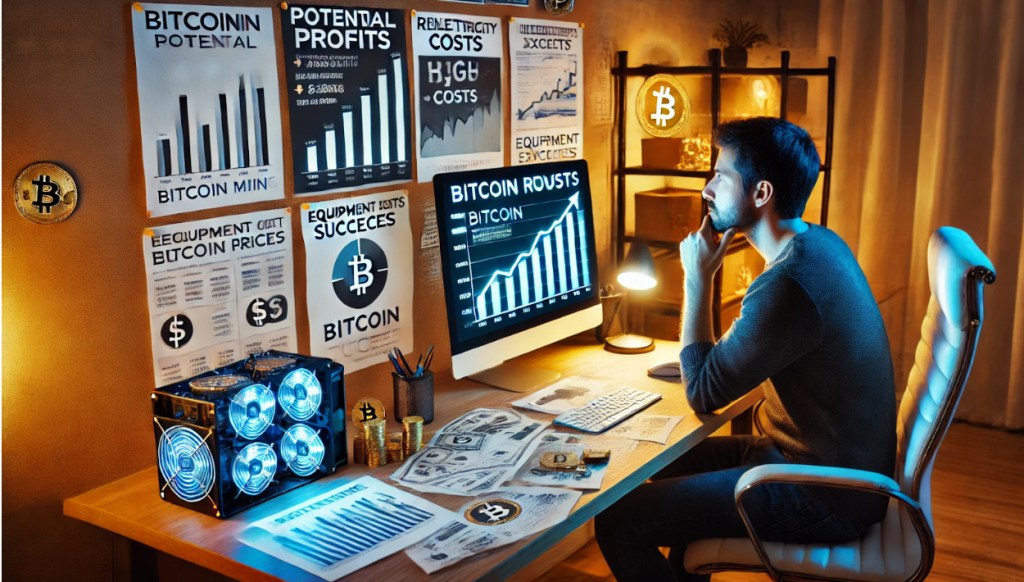
Bitcoin mining as an individual requires a significant upfront investment. When I first looked into mining, I realized that purchasing an ASIC miner like the Antminer S19 could cost thousands of dollars (Bitmain, 2023). Beyond hardware costs, I had to consider electricity, maintenance and cooling expenses. I also needed to evaluate my ability to handle fluctuations in mining profitability, as Bitcoin’s price and mining difficulty constantly change (CoinDesk, 2024).
COST ANALYSIS
- Hardware Costs – ASIC miners range from $2,000 to $10,000, depending on efficiency and performance (MicroBT, 2024). I had to decide whether I was willing to make that upfront investment, if I tried to do it alone.
- Electricity Costs – My local electricity rates significantly impacted my potential profitability. Inexpensive energy sources can make or break a mining operation (Cambridge Centre for Alternative Finance, 2023).
- Maintenance & Infrastructure – I had to think about proper cooling and ventilation for my mining setup, which would add to operational expenses (Blandin et al., 2020).
- Market Trends – The Bitcoin halving cycle impacts mining profitability. I needed to assess my risk tolerance regarding market volatility and ensure I keep re-investing a portion of my profits.
TECHNICAL KNOWLEDGE
Understanding mining algorithms, network hash rate and difficulty adjustments is very important. Before investing, I spent weeks researching how mining works, testing out mining software like CGMiner and BFGMiner and exploring different mining pools and exchanges (Foley et al., 2019). Using the wrong mining pools and/or exchanges could mean that you lose your Bitcoin if they go out of business. I also realized that without proper security practices, my mining operation could be vulnerable to cyber threats. If you’re considering mining, ensure you have the time and willingness to learn the technical side.
ENERGY CONSIDERATIONS
Bitcoin mining consumes a substantial amount of energy and electricity costs can make or break profitability. I started with mining in my home and quickly learned how much residential energy costs erode profits. Then I explored hosting partners who had scaled out infrastructure and access to lower rates which helped me overcome any technical learning curve and brought my energy costs down. Eventually, this allowed me to build relationships with energy partners and find my own locations to build out.
FINDING AND PURCHASING ASIC MINING COMPUTERS
Selecting the right ASIC miner is crucial for a successful mining operation. I spent considerable time researching different models, comparing hash rates, energy efficiency, price points and tested vendors before making any large purchases.
Institutional adoption and infrastructure maturity have solidified Bitcoin’s credibility as a mainstream asset.
- Manufacturer Websites – Companies like Bitmain, MicroBT, and Canaan sell miners directly. Buying from the manufacturer ensures authenticity and warranty support. Although, it is difficult to find availability in a Bull market.
- Resellers and Distributors – Trusted resellers often provide better availability but may charge a premium. I vetted sellers through online forums, personal recommendations and reviews to avoid scams.
- Second-Hand Marketplaces – Platforms like eBay, Craigslist and dedicated mining forums offer used miners. I exercised caution, checking for signs of wear and ensuring the seller had a good reputation.
Factors to Consider When Buying
- Hash Rate vs. Power Consumption – I balanced efficiency with energy costs to maximize profitability. I learned that you always buy the fastest you can afford.
- Cooling Requirements – Some ASIC models generate excessive heat, requiring additional cooling solutions.
- Firmware and Customization – Certain miners allow firmware modifications to improve efficiency, which was an appealing option for me.
- Noise – ASIC miners are loud and when you combine multiple in one room, it can sound like a jet engine is in your house.
- Shipping and Import Fees – I factored in additional costs, especially when purchasing from overseas manufacturers.
PERSONAL GEOPOLITICAL AND FINANCIAL BELIEFS
Bitcoin’s role as a decentralized currency was a major factor in my decision-making process. I believe in financial sovereignty and the importance of censorship-resistant money, which made Bitcoin mining an attractive investment. However, if you’re someone who prefers traditional banking systems and government-backed financial structures, mining might not align with your beliefs.
Political and Economic Stability
- Countries with economic instability or strict capital controls often have higher Bitcoin adoption rates.
- Mining in regions with political uncertainty can lead to abrupt regulatory changes or government intervention.
Inflation and Monetary Policy
- Bitcoin is often compared to gold as a hedge against inflation.
- If you’re concerned about fiat currency devaluation, mining can be a way to accumulate Bitcoin as a store of value.
Ethical and Environmental Considerations
If sustainability is a priority for you, consider using renewable energy sources or carbon offset initiatives.
The environmental impact of Bitcoin mining is frequently debated.
REGULATORY COMPLIANCE
Mining regulations vary widely by country and even by state. Some regions have outright banned mining, while others offer incentives for miners. Before investing, I researched the tax implications and legal requirements in my area (OECD, 2023). Additionally, I considered how AML and KYC regulations might impact how I sell my mined Bitcoin.
KEY QUESTIONS TO ASK YOURSELF BEFORE MINING
Before I made my decision, I asked myself the following key questions. If you’re considering Bitcoin mining, I encourage you to reflect on them as well:
Does Bitcoin mining align with my personal financial and geopolitical beliefs?
Can I afford the upfront investment without jeopardizing my financial security?
Do I have access to affordable electricity or renewable energy sources?
Am I willing to take the time to learn about mining hardware, software and security best practices?
How do I plan to handle market volatility and potential declines in mining profitability?
Do I understand the tax and regulatory implications of mining in my jurisdiction?
Am I comfortable with the long-term commitment required to make mining profitable?
RISK MANAGEMENT
Bitcoin’s price volatility directly impacts mining profitability. To mitigate risk, I considered the following strategies:
- Diversification – Investing in multiple cryptocurrencies or mining pools.
- Operational Flexibility – Adapting to regulatory changes or market shifts.
- Hedging Strategies – Using Bitcoin derivatives to hedge against price drops (Hougan & Lawant, 2022).
- Energy Contracts – Securing long-term energy agreements to stabilize electricity costs.
CONCLUSION
Investing in Bitcoin mining is not a decision to take lightly. After careful evaluation of my financial situation, technical expertise, energy access, regulatory environment and personal beliefs, I determined that mining aligned with my goals. However, it’s not for everyone. By asking yourself the key questions and thoroughly researching the risks, you can make an informed decision about whether Bitcoin mining is right for you.
REFERENCES
Blandin, A., Pieters, G., Wu, Y., et al. (2020). Global cryptocurrency mining: Trends and impact. Cambridge Centre for Alternative Finance. www.jbs.cam.ac.uk/ccaf/
Cambridge Bitcoin Electricity Consumption Index. (2023). Bitcoin electricity consumption. Cambridge Centre for Alternative Finance. cbeci.org
CoinDesk. (2024). Bitcoin mining profitability analysis. www.coindesk.com
Foley, S., Karlsen, J. R., & Putniņš, T. J. (2019). Bitcoin mining pools and centralization risks. Journal of Financial Stability. www.jfs.org
Hougan, M., & Lawant, D. (2022). Hedging Bitcoin price volatility. CFA Institute. www.cfainstitute.org
MicroBT. (2024). ASIC miner specifications. www.microbt.com
Nakamoto, S. (2008). Bitcoin: A peer-to-peer electronic cash system. Bitcoin.org. bitcoin.org/bitcoin.pdf
OECD. (2023). Regulatory approaches to cryptocurrency mining. Organization for Economic Cooperation and Development. www.oecd.org
Stoll, C., Klaaßen, L., & Gallersdörfer, U. (2019). The carbon footprint of Bitcoin mining. Joule, 3(7), 1647–1661. www.joule.com
LEGAL DISCLAIMER
The information provided above is for informational purposes only and does not constitute financial, investment, or legal advice. The predictions and opinions shared are based on publicly available statements and insights from individuals in the Bitcoin and cryptocurrency space and are not guarantees of future performance. Cryptocurrency investments involve significant risks, including market volatility, regulatory changes, and the potential loss of principal.
Always conduct your own research and consult with a qualified financial advisor or legal professional before making any investment decisions. The inclusion of specific predictions or influencers does not imply endorsement or verification of their views, strategies, or affiliations. Past performance and speculative forecasts are not indicative of future results.