EXECUTIVE SUMMARY
This paper evaluates the viability of using Bitcoin (BTC) as a long-term savings vehicle, considering its core properties, historical performance, and macroeconomic relevance. Bitcoin’s fixed supply and decentralized architecture position it as a potential alternative to traditional stores of value like gold and fiat savings. However, volatility, regulatory uncertainty and evolving infrastructure present both opportunities and risks. By reviewing academic literature, market data and real-world case studies, this analysis aims to offer a balanced perspective on Bitcoin’s utility for long-term savers in the modern financial ecosystem.

INTRODUCTION
Savings strategies have traditionally relied on time-tested assets such as government bonds, real estate and savings accounts. These instruments provide relatively low but stable returns with minimal risk. With rising inflation, central bank interventions and global economic instability, questions have emerged about whether these traditional vehicles are still adequate for preserving wealth over the long term.
In contrast, Bitcoin has emerged as a non-sovereign digital asset with a fixed supply and decentralized ledger. Initially created in 2009 by an anonymous figure known as Satoshi Nakamoto, Bitcoin was designed as a peer-to-peer cash system (Nakamoto, 2008). Over the past decade, it has evolved into what many now consider “digital gold,” drawing interest from institutional investors, hedge funds and individuals seeking to diversify their savings.
This paper investigates whether Bitcoin qualifies as a long-term savings asset. It evaluates the asset through the lens of traditional savings criteria—such as security, stability, and inflation resistance—while also exploring its unique advantages and limitations. The objective is to provide a comprehensive and nuanced answer to the question: Can Bitcoin function as a reliable tool for long-term savings?
WHAT MAKES AN ASSET SUITABLE FOR LONG-TERM SAVINGS?
A sound long-term savings vehicle should exhibit several core traits: it must retain or grow in purchasing power, be resistant to devaluation, be relatively liquid and offer a degree of security against both systemic and personal risks. Historically, assets such as gold and U.S. Treasury bonds have fulfilled these criteria, providing investors with stability during economic downturns and inflationary periods.
Long-term savings typically require the following attributes:
- Store of value: The asset retains or increases purchasing power over time.
- Liquidity: It can be converted into fiat or other assets when needed.
- Security: Risk of loss or theft is minimal if managed responsibly.
- Predictability: The asset is relatively stable or predictable in performance.
Assets such as gold and Treasury bonds have historically fulfilled these roles. Bitcoin introduces a new paradigm—digital scarcity enforced through blockchain technology.
Gold has maintained its purchasing power over centuries due to its scarcity, universal acceptance and inert nature. Bonds, while less inflation-resistant, are supported by the credit of sovereign governments and offer predictable returns. These attributes have made them cornerstones of retirement planning and institutional asset management. However, persistent low interest rates and recent spikes in inflation have undermined their long-standing appeal (World Gold Council, 2023).
Bitcoin, by design, introduces an entirely different set of dynamics. With a maximum supply of 21 million coins and issuance halving every four years, Bitcoin is engineered to be deflationary. Furthermore, its decentralized nature offers protection from capital controls and central bank interference. These characteristics present a compelling argument for Bitcoin as a long-term store of value, although they must be weighed against its volatility and lack of historical precedent.
BITCOIN’S CORE PROPERTIES: SCARCITY, SECURITY, AND SELF-CUSTODY
The most distinguishing characteristic of Bitcoin is its fixed supply. Unlike fiat currencies, which can be printed at will by central banks, Bitcoin’s issuance schedule is immutable and transparent. Every four years, the number of new bitcoins mined is halved—a process known as the “halving”—which reduces the rate of new supply. This structure mirrors gold’s scarcity while introducing programmability and verifiability that physical commodities cannot match (Antonopoulos, 2017).
Security in Bitcoin comes not from a central authority but from its underlying cryptographic and distributed ledger system. The Bitcoin blockchain is maintained by thousands of independent nodes worldwide, making it highly resistant to fraud, censorship and manipulation. While users are responsible for safeguarding their private keys, modern tools like hardware wallets and multisignature protocols have made self-custody increasingly secure for long-term savers.
Another unique advantage is Bitcoin’s divisibility and portability. One bitcoin can be divided into 100 million satoshis, allowing for micro-savings. It can also be stored digitally and transported globally with a private key or seed phrase, offering unparalleled portability and resilience in unstable political environments. These traits make Bitcoin not just a modern equivalent of gold, but potentially an even more accessible one.
VOLATILITY AND RISK: A BARRIER TO ADOPTION?
Bitcoin’s price volatility is frequently cited as its most significant weakness as a savings vehicle. Historical drawdowns of 70–80% within a single year have deterred many from viewing it as a stable investment. While long-term holders have seen outsized gains, the short-term price swings can be emotionally and financially taxing for savers accustomed to the stability of bonds or money markets (Yermack, 2013).
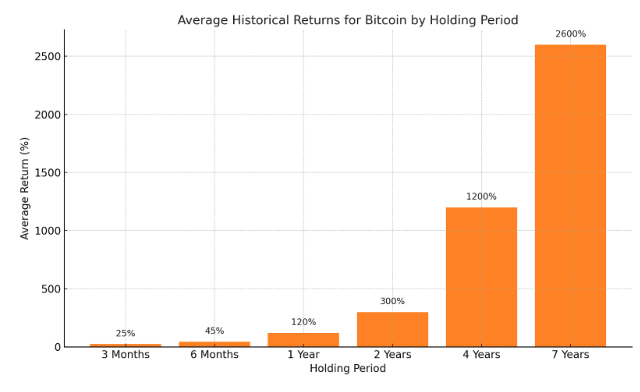
However, proponents argue that this volatility is a function of Bitcoin’s price discovery and increasing adoption. As its market cap grows and liquidity improves, its volatility is expected to decrease—just as it did with gold in the 20th century. Empirical data shows that Bitcoin’s rolling 4-year returns have remained positive for the vast majority of its history, supporting the case for long-term holding rather than short-term speculation (CoinMetrics, 2024).
It is also important to contextualize volatility in light of inflation. While fiat savings may appear stable in nominal terms, their real purchasing power often declines. From this perspective, Bitcoin’s volatility may be more tolerable if it results in long-term appreciation that outpaces inflation, especially in periods of aggressive monetary expansion by central banks.
Since its first recorded price in 2010, Bitcoin has seen extraordinary growth, from under $1 to peaks above $69,000 by 2021 and over $90,000 in 2024. Despite periodic crashes, Bitcoin’s long-term trend has vastly outperformed traditional assets (CoinMarketCap, 2024).
CAGR Comparison (2011–2024):
- Bitcoin: ~80% annually (variable)
- S&P 500: ~10–12%
- Gold: ~1–2%

INFLATION HEDGE AND FIAT CURRENCY ALTERNATIVES
Bitcoin’s design inherently resists inflation. Its capped supply stands in direct opposition to fiat currencies, which have seen significant supply expansion in the past decade. For example, the U.S. money supply (M2) increased by over 40% between 2020 and 2022, raising concerns about long-term currency debasement (Federal Reserve, 2023). Bitcoin, by contrast, offers an asset that cannot be diluted—appealing to savers seeking refuge from fiat devaluation.
Empirical research supports Bitcoin’s correlation with inflationary environments. A study by Liu and Tsyvinski (2021) found that Bitcoin often responds positively to inflation surprises and exhibits characteristics of a digital commodity. Institutional adoption—such as by MicroStrategy and Tesla—reflects a growing belief that Bitcoin can serve as a corporate treasury reserve asset (MicroStrategy, 2023).
Bitcoin also offers an alternative for populations suffering under hyperinflation. In Argentina and Venezuela, where local currencies have become nearly worthless, Bitcoin and stablecoins are increasingly used for saving and cross-border transactions (Chainalysis, 2023). In such contexts, Bitcoin isn’t just a speculative asset—it is a lifeline for financial survival.
THE ROLE OF BITCOIN IN A DIVERSIFIED PORTFOLIO
The financial industry has gradually integrated Bitcoin into mainstream investment strategies. Portfolio managers increasingly treat Bitcoin as an “alternative asset” with potential for asymmetric returns. Studies suggest that allocating 1–5% of a diversified portfolio to Bitcoin can improve overall risk-adjusted returns, even accounting for its volatility (Baur et al., 2018).
Fidelity, BlackRock and other major institutions have launched Bitcoin-related funds and ETFs, signaling growing confidence in the asset’s long-term viability. The U.S. Securities and Exchange Commission (SEC) approved several spot Bitcoin ETFs in early 2024, further legitimizing its role in retirement and brokerage accounts (Fidelity, 2024).
Moreover, technological developments like the Lightning Network are enhancing Bitcoin’s utility for savings and payments alike. While originally criticized for its slow transaction times, Bitcoin now supports faster, cheaper transfers, making it more viable as a savings asset that can also be deployed for daily use if necessary.
PRIVACY AND THE EROSION OF FINANCIAL SURVEILLANCE
Financial privacy has been steadily eroded through Know Your Customer (KYC) and Anti-Money Laundering (AML) regulations. These measures require banks and financial institutions to collect personal information, monitor transactions and report suspicious activity—often without individual consent.
Bitcoin provides an alternative. Its base layer supports pseudonymous addresses that are not inherently linked to real-world identities. Users can increase privacy further through coin-mixing tools like CoinJoin and wallets like Wasabi or Samourai, and by leveraging second-layer solutions like the Lightning Network.
While governments continue to implement regulations aimed at de-anonymizing Bitcoin users, the protocol’s design prioritizes individual control. It becomes increasingly difficult for surveillance regimes to maintain total financial visibility in a world where peer-to-peer transactions bypass traditional gatekeepers.
By restoring financial privacy, Bitcoin protects individuals from unjust persecution, political discrimination and arbitrary asset seizures.
CONCLUSION
Bitcoin embodies a new paradigm in personal finance: a digital, decentralized asset with hard-coded scarcity and global portability. For long-term savers seeking to protect wealth from inflation, monetary debasement, or centralized financial risks, Bitcoin offers an attractive—if volatile—alternative. Its track record, though brief by historical standards, suggests the potential for strong returns and resilience in turbulent economic conditions.
However, Bitcoin is not without its challenges. Its volatility, regulatory status, and reliance on individual custody introduce unique risks. While technological and legal frameworks continue to mature, these concerns remain significant, particularly for conservative investors or those with short time horizons.
Ultimately, Bitcoin may best serve as a component—rather than the foundation—of a long-term savings strategy. By combining Bitcoin with traditional assets, individuals can potentially enhance portfolio resilience and performance. As trust in fiat currencies continues to erode and digital infrastructure expands, Bitcoin’s role in long-term savings strategies may only grow.
REFERENCES
Antonopoulos, A. M. (2017). Mastering Bitcoin: Unlocking digital cryptocurrencies (2nd ed.). O’Reilly Media. https://aantonop.com/books/mastering-bitcoin/
Baur, D. G., Hong, K., & Lee, A. D. (2018). Bitcoin: Medium of exchange or speculative assets? Journal of International Financial Markets, Institutions and Money, 54, 177–189.
Chainalysis. (2023). Crypto Adoption Index 2023. https://www.chainalysis.com/blog/crypto-adoption-index-2023/
CoinMetrics. (2024). Crypto data and metrics. https://coinmetrics.io/
Federal Reserve. (2023). M2 Money Stock (M2SL). FRED, Federal Reserve Bank of St. Louis. https://fred.stlouisfed.org/series/M2SL
Fidelity. (2024). Crypto investment overview. https://www.fidelity.com/crypto/overview
Liu, Y., & Tsyvinski, A. (2021). Risks and returns of cryptocurrency. The Review of Financial Studies, 34(6), 2689–2727.
MicroStrategy. (2023). Bitcoin Corporate Strategy. https://www.microstrategy.com/en/bitcoin
Nakamoto, S. (2008). Bitcoin: A peer-to-peer electronic cash system. https://bitcoin.org/bitcoin.pdf
World Gold Council. (2023). Gold market commentary. https://www.gold.org
Yermack, D. (2013). Is Bitcoin a real currency? An economic appraisal. In Handbook of Digital Currency.
LEGAL DISCLAIMER
The information provided above is for informational purposes only and does not constitute financial, investment, or legal advice. The predictions and opinions shared are based on publicly available statements and insights from individuals in the Bitcoin and cryptocurrency space and are not guarantees of future performance. Cryptocurrency investments involve significant risks, including market volatility, regulatory changes and the potential loss of principal.
Always conduct your own research and consult with a qualified financial advisor or legal professional before making any investment decisions. The inclusion of specific predictions or influencers does not imply endorsement or verification of their views, strategies, or affiliations. Past performance and speculative forecasts are not indicative of future results.