EXECUTIVE SUMMARY
Bitcoin, the first decentralized digital currency, has evolved from a niche experiment into a globally recognized asset. As we project toward the year 2050, this paper explores potential futures for Bitcoin across a spectrum of dimensions including use cases, price outlook, government policy, asset classification, tax treatment, individual sovereignty, government overreach, seamless technological integration and global asset status. While predicting the future remains speculative, current trends in finance, geopolitics, technology and monetary policy provide insight into where Bitcoin may be headed in the decades to come.

INTRODUCTION
Bitcoin (BTC), introduced in 2009 by the pseudonymous Satoshi Nakamoto, aimed to provide a decentralized alternative to fiat currency. Over its first 40 years, Bitcoin has faced scrutiny, admiration, and increasing adoption. By 2050, it may be a central player in global finance, an economic relic, or something in between. This paper evaluates its trajectory using a multidisciplinary lens.
Bitcoin’s evolution has mirrored broader technological and social shifts. From an anonymous PDF shared on a cryptography mailing list, Bitcoin has sparked a global movement, inspired thousands of alternative digital assets, and challenged fundamental assumptions about money. With institutional interest growing and global trust in fiat currencies eroding, Bitcoin’s relevance has only deepened.
By examining the most likely trends and disruptive forces, this paper aims to forecast Bitcoin’s position in the world economy of 2050. Will it serve primarily as a digital store of value, or will technological advancements elevate it to an integral layer of global commerce and governance? The sections that follow explore these possibilities.
USE CASES FOR BITCOIN IN 2050
Bitcoin’s utility in 2050 will likely extend beyond the current narratives of digital gold and a speculative investment. One of the most prominent use cases is as a long-term store of value, functioning akin to gold but with superior characteristics: divisibility, portability and verifiability. Bitcoin’s capped supply of 21 million ensures scarcity, making it an ideal hedge against inflation and fiat currency depreciation.
Another emerging use case is as a global settlement layer. Bitcoin’s Lightning Network and layer-2 protocols enable fast and low-cost transactions, making Bitcoin viable for international trade, remittances and micropayments. Innovations in privacy, scalability, and interoperability could further solidify Bitcoin’s role in global commerce. In developing countries with unstable currencies, Bitcoin might act as a parallel financial system, allowing citizens to save and transact securely.
Finally, Bitcoin may underpin decentralized identity systems and smart contracts. Though traditionally associated with Ethereum, Bitcoin’s development roadmap includes features like Taproot and smart contract integration that could power decentralized finance (DeFi), peer-to-peer lending and autonomous governance structures on a secure, robust chain.
BITCOIN PRICE OUTLOOK
Projecting Bitcoin’s price in 2050 requires a balance between technical modeling and macroeconomic forecasting. The Stock-to-Flow (S2F) model by PlanB remains one of the most discussed valuation frameworks. By linking Bitcoin’s scarcity to its price, the model suggests valuations in the $1–10 million range per BTC by 2050, assuming continued adoption and monetary expansion.
Network effects, described by Metcalfe’s Law, also offer insight. As more participants join the network, Bitcoin’s utility and value increase exponentially. Institutional adoption, sovereign wealth fund allocations and retail integration into financial systems could significantly drive demand. Bitcoin’s correlation to macro trends—such as distrust in fiat currencies, geopolitical unrest and inflation—adds further upward pressure.
However, risks remain. Regulatory crackdowns, protocol vulnerabilities, or the rise of a superior competitor could suppress prices. Still, the long-term trajectory remains positive due to Bitcoin’s first-mover advantage, resilient architecture and expanding awareness.
GOVERNMENT POLICY
Government responses to Bitcoin range from embrace to outright hostility. By 2050, this landscape may bifurcate: some nations may integrate Bitcoin into their financial infrastructure, while others may attempt to suppress it in favor of Central Bank Digital Currencies (CBDCs).
El Salvador’s adoption of Bitcoin as legal tender in 2021 marked a turning point. By 2050, more nations with weak currencies may follow, leveraging Bitcoin as a hedge against monetary instability. Conversely, powerful states may resist Bitcoin’s decentralization by enforcing strict regulations on exchanges, wallets and miners.
Geopolitical dynamics will shape outcomes. Bitcoin could act as a tool for economic sovereignty, especially in countries marginalized by global financial institutions. Governments may eventually realize that regulating rather than banning Bitcoin allows for consumer protection and innovation without stifling economic freedom.
ASSET CLASSIFICATION
Bitcoin’s legal status varies globally—from commodity to currency to property. In the U.S., Bitcoin is classified as property by the IRS and a commodity by the CFTC. By 2050, unified regulatory frameworks may emerge as nations seek to harmonize digital asset policies.
A likely scenario is the creation of a new asset class: digital monetary commodities. This classification would distinguish Bitcoin from securities and fiat currencies, acknowledging its monetary role while accounting for its decentralized nature. This could simplify compliance and encourage broader institutional adoption.
Such classification will influence taxation, custody and accounting practices. If treated akin to a base layer financial instrument, Bitcoin could be integrated into banking infrastructure and insurance products, establishing it as a legitimate foundation for digital wealth.
TAXATION
Tax regimes around Bitcoin are evolving. Presently, most jurisdictions treat Bitcoin as a taxable asset, triggering capital gains events upon sale or use. By 2050, as usage becomes widespread, tax laws may adapt to reflect its role in everyday commerce.
One possible development is a de minimis exemption for small transactions. This would enable Bitcoin to function more fluidly as a medium of exchange without the burden of calculating gains on each coffee purchase. Countries fostering Bitcoin economies may offer tax incentives for holding or transacting in Bitcoin.
Moreover, jurisdictions may compete for digital capital by offering favorable tax treatments. Just as tax havens attract fiat wealth, crypto-friendly nations could attract Bitcoin users, businesses and developers—transforming taxation from a compliance burden into a competitive advantage.
INDIVIDUAL SOVEREIGNTY
Bitcoin represents a revolutionary tool for individual sovereignty, empowering people to control their own wealth without intermediaries. This stands in stark contrast to the centralized nature of traditional financial systems, where banks and governments can freeze assets, impose capital controls, or debase currency value.
By 2050, Bitcoin may serve as a financial sanctuary for individuals in oppressive regimes or unstable economies. Self-custody through hardware wallets and multisig setups allows users to store value securely and privately. Innovations in privacy protocols, such as CoinJoin and Taproot, enhance user anonymity and protect against surveillance.
Beyond finances, Bitcoin’s decentralized ethos may inspire broader societal change. With its trustless, permissionless architecture—Bitcoin encourages people to think critically about authority, governance and individual rights—potentially influencing how future generations organize, govern and defend their autonomy.
GOVERNMENT OVERREACH
Government overreach presents one of the most potent threats to Bitcoin’s promise of decentralization and freedom. Throughout history, states have seized wealth, restricted capital flows and censored dissent—all in the name of public interest. Bitcoin offers a peaceful alternative: a censorship-resistant money immune to state control.
By 2050, digital authoritarianism may become more prevalent as states deploy CBDCs with programmable features and surveillance capabilities. In this environment, Bitcoin offers a parallel system that resists manipulation. Its distributed network and cryptographic integrity make it uniquely equipped to resist political and monetary overreach.
However, this resistance may invite backlash. Governments could attempt to ban self-custody, require invasive KYC/AML measures, or label Bitcoin as a tool for terrorism or tax evasion. The Bitcoin community’s resilience, legal advocacy and education efforts will be critical in defending the right to financial freedom.
BITCOIN AS THE GLOBAL ASSET OF CHOICE
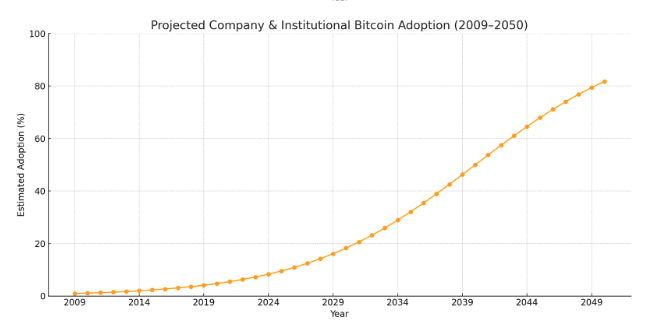
As global economic paradigms shift, Bitcoin is increasingly poised to become the asset of choice across diverse markets. This evolution is rooted in its unique qualities: absolute scarcity, decentralization and programmability. With trust in fiat currencies waning and the need for a neutral, globally recognized store of value rising, Bitcoin’s appeal is likely to grow exponentially by 2050.
Historically, the U.S. dollar and gold have played dominant roles in international finance. However, these traditional assets face challenges in an era of debt monetization, currency wars and declining faith in centralized authorities. Bitcoin, by contrast, offers a transparent, algorithmically defined monetary policy, immune to political manipulation. Its borderless nature makes it an ideal candidate for global coordination without reliance on any single nation’s infrastructure or ideology.By 2050, it’s plausible that Bitcoin could serve as a foundational pillar of wealth preservation for sovereign wealth funds, pension systems, and institutional portfolios. With increasing integration into digital financial services, Bitcoin may become the default collateral layer and settlement asset in both retail and high-value transactions. As fiat systems continue to erode under inflationary pressure and unsustainable debt, Bitcoin’s credibility as a non-sovereign, apolitical alternative could make it the global standard for value.

SEAMLESS INTEGRATION INTO MOBILE AND DIGITAL TECHNOLOGIES
A defining feature of Bitcoin in 2050 will be its seamless integration into mobile and digital ecosystems. The convergence of blockchain technology with smartphones, wearable devices and internet-of-things (IoT) platforms will allow Bitcoin wallets to be as ubiquitous and user-friendly as modern banking apps.
By 2050, mobile Bitcoin wallets are expected to incorporate biometric security, real-time Lightning Network connectivity and AI-powered asset management tools. These features will offer intuitive interfaces and instant transaction capabilities, enabling everyday users to send, receive and store Bitcoin with minimal technical knowledge.
Furthermore, widespread API support and modular integration will allow Bitcoin functionality to become native to operating systems, messaging apps and e-commerce platforms. As a result, Bitcoin will transition from a specialized asset to an embedded component of the digital lifestyle—reinforcing its role as both a financial tool and a cornerstone of decentralized infrastructure.
CONCLUSION
Bitcoin in 2050 may be unrecognizable compared to its early days—a core pillar of a digitized, decentralized financial system. It could serve as a global reserve, facilitate instant borderless commerce and empower individuals against inflation and authoritarianism. Its fixed supply and decentralized governance structure provide a rare economic constant in a rapidly changing world.
However, its path is not guaranteed. Success depends on the collective will of developers, users, policymakers and institutions to maintain its integrity. Challenges such as energy consumption, scalability and regulatory uncertainty must be met with innovation, resilience and informed advocacy. If met wisely, these challenges can act as catalysts rather than obstacles.In the final analysis, Bitcoin’s potential in 2050 lies not only in its technology but in the values it represents: freedom, transparency and sovereignty. As the world grapples with digital transformation, inflation and erosion of privacy, Bitcoin stands as a beacon for a more equitable financial future. The journey toward 2050 is an opportunity to shape that future intentionally and collaboratively. It is a test of our collective vision for open finance, individual empowerment and a monetary system grounded in fairness rather than fiat. With the right stewardship, Bitcoin has the potential to become not just a technological innovation, but a civilizational cornerstone.
REFERENCES
Burniske, C., & Tatar, J. (2017). Cryptoassets: The Innovative Investor’s Guide to Bitcoin and Beyond. McGraw-Hill Education.
Carter, N. (2022). How Bitcoin Mining Can Drive Clean Energy Innovation. Harvard Business Review. Retrieved from https://hbr.org/2022/01/how-bitcoin-mining-can-drive-clean-energy-innovation
Casares, W. (2020). Bitcoin and the Interplanetary Economy. Retrieved from https://www.bitcoininterplanetary.org/
Chainalysis. (2023). Crypto Adoption Index. Retrieved from https://www.chainalysis.com/
Friedrich, M. (2021). The Bitcoin Standard Playbook. Independent Publishing.
Leishman, C. (2023). Bitcoin’s Lightning Future. CoinDesk. Retrieved from https://www.coindesk.com
Nakamoto, S. (2008). Bitcoin: A Peer-to-Peer Electronic Cash System. Retrieved from https://bitcoin.org/bitcoin.pdf
PlanB. (2020). Modeling Bitcoin Value with Scarcity. Retrieved from https://medium.com/@100trillionUSD
Szabo, N. (2011). The Origins of Money. Retrieved from https://nakamotoinstitute.org/the-idea-of-smart-contracts/
Yassine Elmandjra. (2023). Big Ideas: Bitcoin’s Future. ARK Invest. Retrieved from https://ark-invest.com
Zhao, W. (2022). Bitcoin Mining and Green Energy. MIT Technology Review. Retrieved from https://www.technologyreview.com
LEGAL DISCLAIMER
The information provided above is for informational purposes only and does not constitute financial, investment, or legal advice. The predictions and opinions shared are based on publicly available statements and insights from individuals in the Bitcoin and cryptocurrency space and are not guarantees of future performance. Cryptocurrency investments involve significant risks, including market volatility, regulatory changes and the potential loss of principal.
Always conduct your own research and consult with a qualified financial advisor or legal professional before making any investment decisions. The inclusion of specific predictions or influencers does not imply endorsement or verification of their views, strategies, or affiliations. Past performance and speculative forecasts are not indicative of future results.