EXECUTIVE SUMMARY
Bitcoin, the first decentralized digital currency, has evolved from a niche technological experiment into a mainstream financial asset. Over the years, institutional adoption has played a pivotal role in legitimizing Bitcoin as an investment class. This paper explores the institutions investing in Bitcoin as of January 2025, analyzing their motivations, strategies, and implications for the cryptocurrency market.

INTRODUCTION
Bitcoin has emerged as a transformative force in the global financial landscape—offering an alternative to traditional investment vehicles. What began as an experimental technology has evolved into a trillion-dollar asset class, driven in part by the adoption of institutional investors. These entities, ranging from hedge funds and publicly traded corporations to pension funds and sovereign wealth funds—have recognized Bitcoin’s potential as a store of value, inflation hedge and diversification tool.
The entry of institutional investors has not only brought greater legitimacy to Bitcoin—this has also contributed to its increased stability and liquidity. Countries like the United States and Canada have been at the forefront of this trend, supported by favorable regulatory developments and the introduction of Bitcoin-focused investment products. This paper seeks to provide an in-depth analysis of the institutions investing in Bitcoin, their geographical and strategic trends, and the broader implications of their involvement for the cryptocurrency market.
TYPES OF INSTITUTIONS INVESTING IN BITCOIN
Hedge Funds and Asset Managers
Hedge funds and asset management firms were among the earliest institutional adopters of Bitcoin. Prominent firms such as Grayscale Investments, Pantera Capital, and Galaxy Digital have been active participants—offering Bitcoin-focused investment vehicles. Grayscale’s Bitcoin Trust (GBTC), for example, allows institutional and retail investors to gain exposure to Bitcoin through traditional investment accounts.
Publicly Traded Companies
Corporations have increasingly added Bitcoin to their balance sheets as a hedge against inflation and currency devaluation. Notable examples include:
- MicroStrategy: As of January 2025, MicroStrategy remains one of the largest corporate holders of Bitcoin, with over 158,000 BTC (source).
- Tesla: Despite fluctuations in its Bitcoin holdings, Tesla’s 2021 announcement of a $1.5 billion investment in Bitcoin was a turning point for institutional adoption (source).
- Block (formerly Square): This payments company, led by Jack Dorsey, has consistently invested in Bitcoin as part of its long-term strategy (source).
Institutional Investment Funds
Pension funds, endowments and sovereign wealth funds have gradually entered the Bitcoin market. For instance:
- The Teacher Retirement System of Texas has reportedly allocated a small percentage of its portfolio to cryptocurrency-related investments.
- University endowments, such as those of Harvard, Yale, and Stanford, have made indirect investments in Bitcoin through venture capital funds.
Traditional Financial Institutions
Established banks and financial service providers are increasingly offering Bitcoin-related services to their clients. Examples include:
- Fidelity Investments: A pioneer in cryptocurrency custody and trading services for institutional clients (source).
- BlackRock: The world’s largest asset manager has successfully launched a Bitcoin spot ETF and offers Bitcoin-related investment products (source).
- Goldman Sachs: Actively provides Bitcoin derivatives and market-making services (source).
Exchange-Traded Funds (ETFs)
The introduction of Bitcoin ETFs has provided a regulated and accessible way for institutions to invest in Bitcoin. The launch of ProShares Bitcoin Strategy ETF (BITO) in 2021 marked a significant milestone. Recent developments, such as BlackRock’s filing for a spot Bitcoin ETF, highlight growing institutional interest.
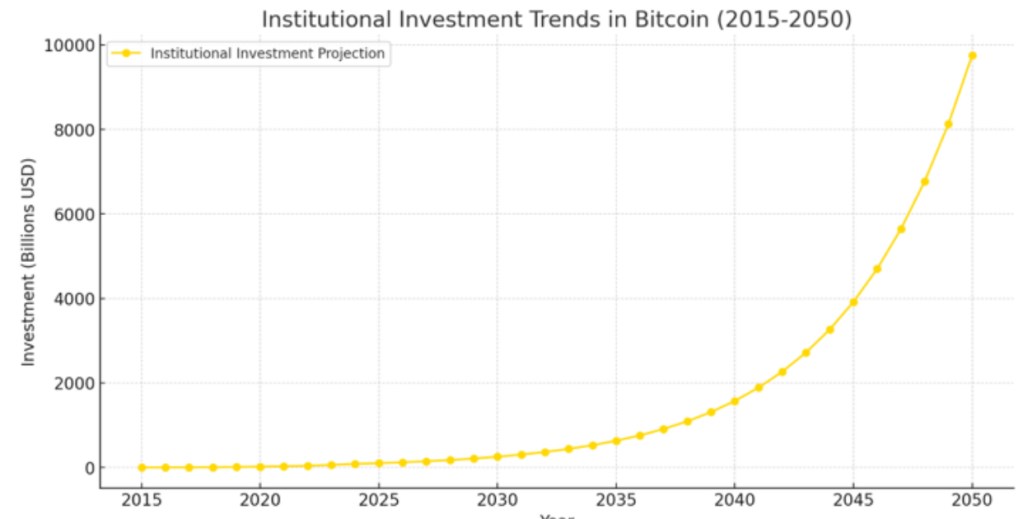
MAJOR INSTITUTIONAL INVESTORS AND THEIR HOLDINGS
| Institution | Investment Total (BTC) | Notable Actions |
| MicroStrategy | 158,000 | Largest corporate Bitcoin holder |
| Tesla | ~10,000 | Significant balance sheet allocation in 2021 |
| Block (formerly Square) | ~8,000 | Long-term Bitcoin strategy for payments |
| Grayscale Investments | ~620,000 | Manages Bitcoin Trust (GBTC) for retail and institutional clients |
| Galaxy Digital | ~40,000 | Focuses on cryptocurrency investments |
| Marathon Digital Holdings | ~13,000 | Leading Bitcoin mining company with substantial holdings |
| BlackRock | N/A (indirect exposure) | Filed for Bitcoin Spot ETF and offers Bitcoin-related products |
| Fidelity Investments | N/A (indirect exposure) | Offers cryptocurrency custody and trading services |
| Harvard, Yale Endowments | N/A (indirect exposure) | Invested indirectly through venture capital funds |

GEOGRAPHIC TRENDS AND NATIONAL POLICIES
United States
The United States leads the institutional Bitcoin market, with a robust ecosystem of exchanges, custodians, and regulatory frameworks. Regulatory developments by agencies such as the SEC and CFTC shape the landscape, while states like Wyoming have enacted crypto-friendly laws. Major cities like Miami and Nashville have both claimed their intent to become Bitcoin capitals of the world.
Canada
Canada was the first country to approve a Bitcoin ETF, with offerings like the Purpose Bitcoin ETF gaining traction among institutional investors. The country’s progressive stance has fostered innovation in the cryptocurrency sector.
European Union
Several European countries, including Germany and Switzerland, have embraced Bitcoin through favorable regulations and institutional participation. For example, German institutional funds can allocate up to 20% of their assets to cryptocurrencies.
El Salvador
El Salvador became the first country to adopt Bitcoin as legal tender in 2021. The government has invested heavily in Bitcoin and launched initiatives such as Bitcoin City to attract investment and tourism.
Asia
In Asia, countries like Singapore and Japan have established themselves as hubs for institutional Bitcoin investment, offering clear regulatory frameworks and robust infrastructure.
Other Regions
Countries in the Middle East, such as the UAE, are also emerging as players in the institutional Bitcoin market, driven by initiatives in blockchain and fintech.
MOTIVATIONS FOR INSTITUTIONAL INVESTMENT
Portfolio Diversification
Bitcoin’s low correlation with traditional asset classes makes it an attractive tool for diversification.
Inflation Hedge
With its fixed supply of 21 million coins, Bitcoin is often compared to gold as a hedge against inflation and currency devaluation.
Technological Innovation
Institutions recognize Bitcoin as the cornerstone of blockchain technology, which underpins broader innovations in decentralized finance (DeFi) and Web3.
CHALLENGES AND RISKS
Regulatory Uncertainty
Regulatory developments continue to impact institutional adoption, with governments worldwide adopting varied approaches to cryptocurrency regulation.
Market Volatility
Bitcoin’s price volatility poses risks for institutions seeking stable returns.
Custody and Security
Safeguarding digital assets requires advanced custody solutions, which some institutions view as a barrier to entry.
IMPLICATIONS OF INSTITUTIONAL ADOPTION
Market Maturity
Institutional participation has contributed to increased liquidity and reduced volatility in the Bitcoin market.
Mainstream Acceptance
Investments by reputable institutions lend credibility to Bitcoin, encouraging broader adoption.
Price Impact
Institutional demand has been a key driver of Bitcoin’s price appreciation, particularly during bull markets.
CONCLUSION
Bitcoin’s integration into the portfolios of major institutional investors signifies a paradigm shift in the financial industry. As of January 2025, institutions ranging from hedge funds to publicly traded companies and pension funds have positioned themselves at the forefront of this digital revolution. Their investments have bolstered Bitcoin’s reputation as a legitimate asset class and catalyzed its adoption on a global scale.
While challenges such as regulatory uncertainty and market volatility remain, the long-term implications of institutional involvement are profound. Increased liquidity, broader acceptance, and innovative financial products are paving the way for Bitcoin’s future. As institutional interest continues to grow, Bitcoin is poised to solidify its status as a cornerstone of the modern financial ecosystem.
REFERENCES
Grayscale Investments. (2025). Company website and reports. Retrieved from www.grayscale.com/
MicroStrategy. (2025). Corporate filings and press releases. Retrieved from www.microstrategy.com/
Fidelity Investments. (2025). Institutional offerings in digital assets. Retrieved from www.fidelity.com/
ProShares. (2025). Bitcoin Strategy ETF documentation. Retrieved from www.proshares.com/
BlackRock. (2025). Public announcements and filings. Retrieved from www.blackrock.com/
LEGAL DISCLAIMER
The information provided above is for informational purposes only and does not constitute financial, investment, or legal advice. The predictions and opinions shared are based on publicly available statements and insights from individuals in the Bitcoin and cryptocurrency space and are not guarantees of future performance. Cryptocurrency investments involve significant risks, including market volatility, regulatory changes, and the potential loss of principal.
Always conduct your own research and consult with a qualified financial advisor or legal professional before making any investment decisions. The inclusion of specific predictions or influencers does not imply endorsement or verification of their views, strategies, or affiliations. Past performance and speculative forecasts are not indicative of future results.